

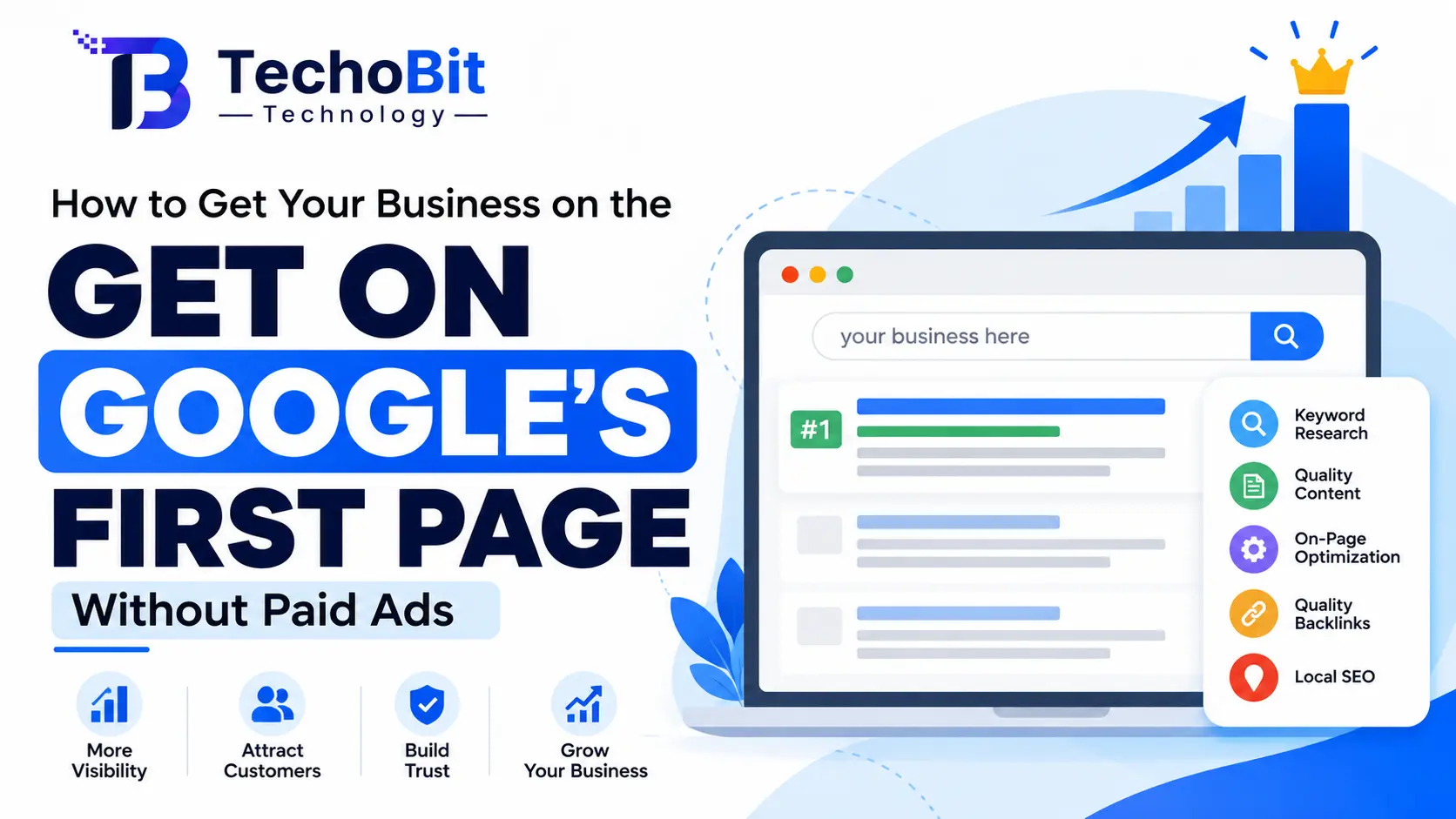
Every business wants to appear on the first page of Google when potential customers search for its products or services. Whether you run a small business, an online store, or a service-based company, ranking higher in search results can help you attract visitors, build trust, and generate more enquiries.
The good news is that you do not always need paid advertising to get website traffic. With the right search engine optimization (SEO) strategy, you can improve your website's visibility and attract people who are already searching for what your business offers.
However, organic rankings take time, and no SEO strategy can guarantee the first position. The key is to build a useful, technically sound website that deserves to appear in relevant search results.
In this guide, we will explain how to get your business on the first page of Google without paid ads using practical SEO techniques.
1. Understand How Google Search Rankings Work
Google uses automated systems to discover, understand, and rank web pages according to their relevance and usefulness for a particular search.
When someone searches for a service, Google tries to provide results that best match the user's needs. Your website's visibility can depend on factors such as content relevance, page accessibility, the quality of information, and signals that help establish trust.
For example, if you offer website development services, your website should clearly explain your services, demonstrate your expertise, and answer questions potential customers might have.
Organic SEO differs from paid advertising because you do not pay Google for each click on an organic search result. Instead, you work to improve your website's ability to appear naturally in relevant searches.
2. Find the Right Keywords for Your Business
Keyword research is one of the first steps in an effective SEO strategy. It helps you understand what your potential customers type into Google when looking for your products or services.
Instead of choosing keywords based only on popularity, focus on terms that match your services and the needs of your target audience.
For example, a web development company could target keywords such as:
Website development services for small businesses
Affordable business website development
Custom website design services
How much does a business website cost?
Best website design company for startups
These keywords represent different search intentions. Some users want to hire a service provider, while others are researching a problem before making a decision.
Use tools such as Google Keyword Planner, Google Trends, and Google Search Console to discover keyword ideas and understand how people find your website.
Tip: Assign a primary search intent to each page. Avoid creating several articles that all target essentially the same query, as this can create unnecessary overlap between your own pages.
3. Optimize Your Website's On-Page SEO
On-page SEO helps search engines understand the subject of each page and helps visitors find the information they need.
Start by optimizing these important elements:
Page titles: Write a unique, descriptive title that accurately reflects the content and includes the main keyword naturally.
Meta descriptions: Summarize the page's value in clear language. A good description can encourage searchers to click, although Google may generate a different snippet.
Headings: Organize the content using a clear H1 heading and relevant H2 and H3 subheadings.
URLs: Use short, descriptive URLs that make the page topic easy to understand.
Images: Use relevant images with descriptive file names and useful alt text.
Internal links: Link to related service pages and blog posts using meaningful anchor text.
For example, a blog about organic search visibility could link to your SEO services when discussing professional website optimization. Link directly to the relevant SEO service page if your website has a dedicated URL for that service.
Strong on-page SEO makes your content easier to navigate and helps search engines interpret its purpose.
4. Publish Helpful, High-Quality Content
Content is an important part of building organic visibility. Your blog should answer real questions, solve problems, and provide information that readers can use.
Instead of publishing generic articles simply to include keywords, focus on creating useful resources for your target audience.
For example, a digital marketing company could publish articles about:
How to improve website rankings without paid advertising
Common SEO mistakes that prevent websites from ranking
How local SEO helps small businesses attract customers
How to choose the right digital marketing strategy
How website speed affects user experience
Include practical steps, examples, relevant screenshots, and original insights wherever possible.
A useful article should answer the reader's main question early, then provide enough detail to help them take the next step. You can also include relevant FAQs to address additional questions.
Google recommends creating helpful, reliable, people-first content rather than content designed primarily to manipulate search rankings.
5. Improve Your Website's Technical SEO
Even excellent content can struggle to appear in search results if search engines cannot properly access or understand the website.
Technical SEO helps ensure that your website can be crawled, indexed, and used effectively.
Check the following elements:
XML sitemap: Create and maintain a sitemap containing the canonical URLs you want search engines to discover.
Robots.txt: Make sure the file does not accidentally block important pages from crawling.
Indexing: Check whether important pages are indexed and whether unwanted
noindexdirectives are present.Mobile usability: Make sure your website works well on smartphones and tablets.
Page speed: Reduce unnecessary scripts, optimize images, and improve loading performance.
HTTPS: Secure your website with HTTPS.
Broken links: Fix broken internal links and redirect outdated URLs when appropriate.
Use Google Search Console to monitor indexing, search performance, and technical issues.
Remember that allowing a page to be crawled does not automatically guarantee that Google will index or rank it.
6. Use Local SEO to Reach Nearby Customers
If your business serves a particular city or geographic area, local SEO can help you become more visible to nearby customers.
For example, a customer might search for a web development company in their city or a digital marketing agency near them.
To strengthen your local search presence:
Create or claim your Google Business Profile if your business is eligible.
Provide accurate business information, categories, contact details, and service descriptions.
Keep your business hours and other details up to date.
Add genuine photos that represent your business.
Encourage satisfied customers to leave honest reviews.
Respond professionally to customer reviews.
Create useful location-specific pages only when you can provide genuinely relevant local information.
Your website and business profile should present consistent, accurate information.
Local SEO is especially useful for eligible businesses serving local customers. However, local results and ordinary organic website rankings are not identical, so each requires an appropriate strategy.
7. Build Quality Backlinks Naturally
Backlinks are links from other websites to your website. They can help people discover your content and provide useful context about your business.
However, not all backlinks provide the same value. Focus on earning relevant links from trustworthy websites rather than collecting large numbers of low-quality links.
Here are some practical ways to build backlinks:
Publish original research, useful guides, or industry resources.
Contribute expert insights to relevant publications.
Build genuine relationships with businesses in related industries.
Get listed in legitimate, relevant business directories.
Create shareable resources that other websites may reference.
Look for relevant unlinked brand mentions and request a link where appropriate.
Avoid buying links intended to manipulate rankings or participating in link schemes. Focus on relevance, editorial value, and sustainable link-building practices.
For businesses that need a structured approach, professional SEO services can help identify technical issues, improve content, and develop a relevant link acquisition strategy.
8. Improve Website Speed and User Experience
A website should not only attract visitors; it should also make it easy for them to find information and contact your business.
If a website loads slowly, displays poorly on mobile devices, or makes navigation difficult, visitors may struggle to complete their intended actions.
Improve the experience by:
Compressing and resizing images.
Using a reliable hosting service.
Removing unnecessary plugins and scripts.
Making navigation simple and intuitive.
Using readable fonts and clear headings.
Placing contact information and calls to action where visitors can find them.
Testing important pages on both desktop and mobile devices.
Use PageSpeed Insights to review performance and identify opportunities for improvement.
A fast, user-friendly website supports your overall SEO efforts while making it easier for potential customers to enquire about your services.
9. Track Your SEO Performance with Google Search Console
SEO is an ongoing process, so you need to measure what is working.
Google Search Console helps you understand how your website performs in Google Search.
Monitor these metrics:
Impressions: How often your pages appear in search results.
Clicks: How many times users click through to your website.
Click-through rate (CTR): The percentage of impressions that result in clicks.
Average position: An aggregated indicator of where your results appear for recorded searches.
Search queries: The terms people use to discover your pages.
Indexing status: Whether Google has indexed your important URLs.
Review this information regularly. If a page receives impressions but few clicks, consider whether its title and description clearly communicate its value. If a page receives little visibility, investigate its search intent, content quality, internal links, and indexing status.
Use the findings to improve existing pages instead of publishing new content without a clear purpose.
10. How Long Does It Take to Reach the First Page of Google?
There is no fixed timeline for achieving first-page rankings.
Some pages may begin receiving impressions relatively quickly, while competitive search terms can require sustained optimization over a longer period.
Results depend on factors such as:
Competition for the target keyword.
Your website's existing authority and history.
Content relevance and usefulness.
Technical health and indexing.
The quality and relevance of external links.
Your consistency in improving the website.
Focus on measurable progress, such as increased impressions, relevant organic clicks, better visibility for target queries, and more qualified enquiries.
Avoid anyone promising guaranteed first-page rankings within a specific number of days.
Conclusion
Getting your business on the first page of Google without paid ads is possible, but it requires a consistent and well-planned SEO strategy.
Start with keyword research, optimize your website pages, publish useful content, fix technical issues, strengthen your local search presence where relevant, and earn quality backlinks naturally. Then use Google Search Console to measure performance and identify opportunities for improvement.
The goal is not simply to rank for more keywords. It is to help the right people discover your business when they are looking for solutions you provide.
At TechoBit Technology, we believe that an effective digital presence combines useful content, a well-optimized website, and a clear strategy for reaching potential customers. Explore our website to learn more about our digital and IT solutions.
Frequently Asked Questions (FAQs)
1. How can I get my business on the first page of Google without paying?
You can improve your chances through organic SEO by researching relevant keywords, publishing useful content, optimizing website pages, fixing technical issues, and earning relevant backlinks. Rankings are not guaranteed.
2. Can a new website rank on the first page of Google?
Yes. A new website can rank for relevant searches if its pages are accessible, useful, and well optimized. However, competitive keywords may take longer to rank for than more specific search queries.
3. How long does SEO take to show results?
SEO timelines vary by website, competition, and the work required. It may take several months to see meaningful improvements, and highly competitive terms can take longer.
4. Is SEO better than Google Ads?
SEO can generate organic traffic without paying for each click, while Google Ads can provide paid visibility for selected searches. The right choice depends on your budget, timeline, competition, and business goals.
5. How do I check whether my website is ranking on Google?
Use Google Search Console to review search queries, impressions, clicks, click-through rates, and average positions. You can also check whether important pages are indexed.
6. Do backlinks help a website rank higher on Google?
Relevant, editorially earned backlinks can help search engines discover pages and provide useful context about their credibility. However, backlinks alone cannot guarantee higher rankings.
7. Can I do SEO myself without hiring an agency?
Yes. You can start with keyword research, useful content, basic on-page optimization, Google Search Console, and technical checks. More complex websites may benefit from professional SEO support.
8. What is the difference between local SEO and regular SEO?
Local SEO focuses on visibility for geographically relevant searches, including eligible business listings and local results. Regular organic SEO focuses on improving website visibility across relevant searches more broadly.